
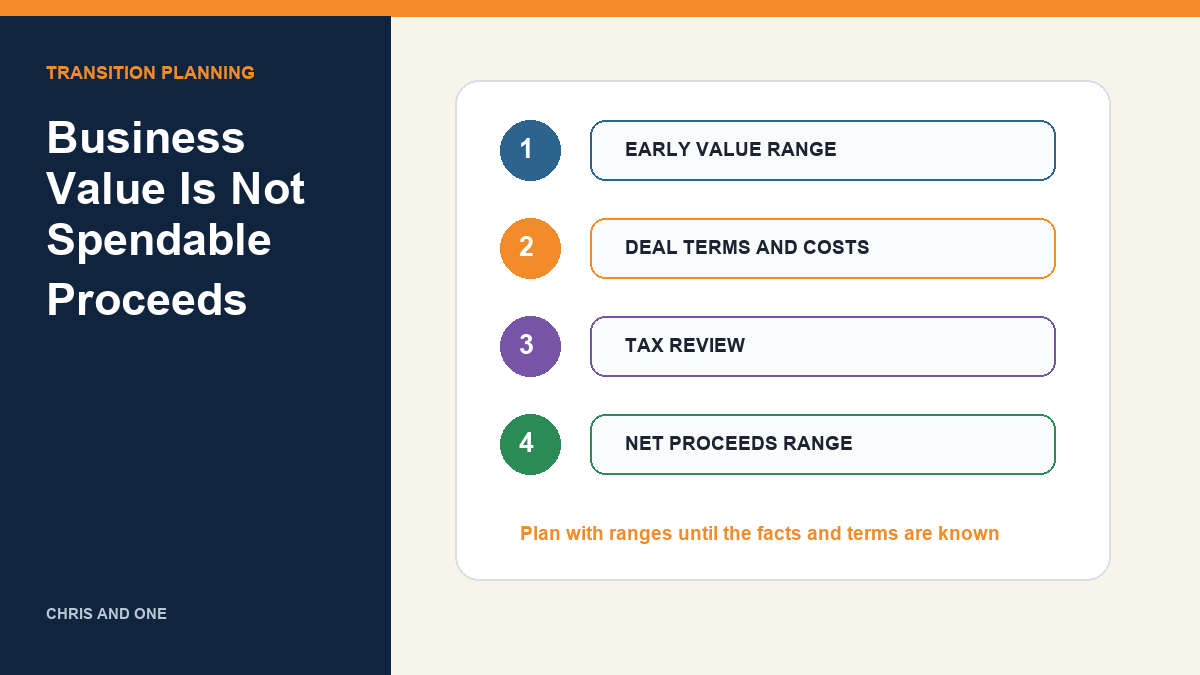
Establishing the Baseline for Transition
When an individual begins contemplating a significant shift in their professional life, establishing a clear and realistic baseline is paramount. The journey from managing a daily operation to stepping into a new phase requires careful orchestration of personal expectations, financial realities, and long-term objectives. Without a grounded understanding of the initial starting point, subsequent plans remain vulnerable to unforeseen disruptions and emotional stress.
The foundation of this planning process must rely on verified data rather than optimistic projections. Many individuals make the critical error of building their future life architecture on assumptions about abstract financial figures. A robust strategy necessitates strict separation between preliminary planning estimates and a formal transaction conclusion. Building scenario ranges allows for flexibility and ensures that personal stability is not entirely dependent on a single, inflexible outcome.
Separating Business Value from Net Proceeds
A fundamental principle in structural transition planning is recognizing the stark difference between a conceptual enterprise valuation and the actual net proceeds received. Individuals frequently conflate these two concepts, leading to significant miscalculations in their personal budgets. The theoretical worth of an operation does not translate directly into available liquid capital.
Understanding this distinction is vital for maintaining realistic expectations. The Internal Revenue Service, Sale of a Business guide explains that a business sale is generally treated for federal tax purposes as a sale of separate assets, with treatment depending on the assets and transaction facts. Sale price, tax treatment, transaction costs, liabilities, and net proceeds are separate concepts, and qualified tax advice should address the specific circumstances.
When evaluating the landscape, one must account for the numerous variables that reduce the final available capital. Transaction costs, including legal fees, professional assessments, and intermediary commissions, can represent a substantial portion of the overall figure.
Building Resilient Scenario Ranges
In the realm of long-term planning, rigidity is a liability. Relying on a single, fixed numerical outcome to dictate future lifestyle choices introduces unacceptable levels of risk. Instead, individuals must develop robust scenario ranges that account for various market conditions, operational shifts, and personal contingencies. This methodology ensures that the personal transition plan can withstand unexpected fluctuations.
A resilient strategy begins with the acknowledgment that external factors are often beyond the individual’s control. Developing best-case, moderate, and conservative scenarios allows for a dynamic response to unfolding events. It is critical to use these diverse scenarios to map out potential pathways, rather than anchoring to a specific, unverified figure.
A step-by-step life-planning framework can help turn that adaptability into concrete choices. A well-constructed plan uses safety margins so that essential living expenses and core objectives do not depend entirely on the most optimistic projection.
The Importance of Owner Role Replacement
A critical component of any professional transition is the systematic replacement of the individual’s role within the operation. An enterprise that relies entirely on the unique skills, relationships, or institutional knowledge of a single person lacks structural independence. Before a successful transition can occur, the operational responsibilities must be fully documented and delegated.
Consider the personal transition after selling a business; the emotional and psychological separation is deeply tied to the operational separation. If the individual remains inextricably linked to the daily workflows, the transition is incomplete.
Evaluating Operational Independence
| Operational State | Owner Involvement | Systemic Structure | Transition Readiness |
|---|---|---|---|
| Highly Dependent | Essential for daily function and decision making | Minimal documentation, undocumented workflows | Low (Significant risk of disruption) |
| Partially Delegated | Required for strategic choices and key client relations | Basic procedures outlined, some tasks assigned | Moderate (Requires further systematization) |
| Structurally Independent | Minimal; acts primarily as an advisor or observer | Comprehensive documentation, cross-trained team | High (Ready for clean operational handoff) |
Navigating Transaction Costs and Professional Review
Executing a significant professional transition involves navigating a complex web of administrative and legal requirements. Individuals must accurately account for the myriad of transaction costs that inevitably arise during this process. Failing to adequately budget for these expenses can severely impact the final resources available for the personal transition plan.
Qualified legal, financial, and tax review can identify facts and obligations that a personal planning worksheet may miss. The U.S. Small Business Administration, Close or sell your business resources recommend determining value before a sale and considering appropriate professional guidance.
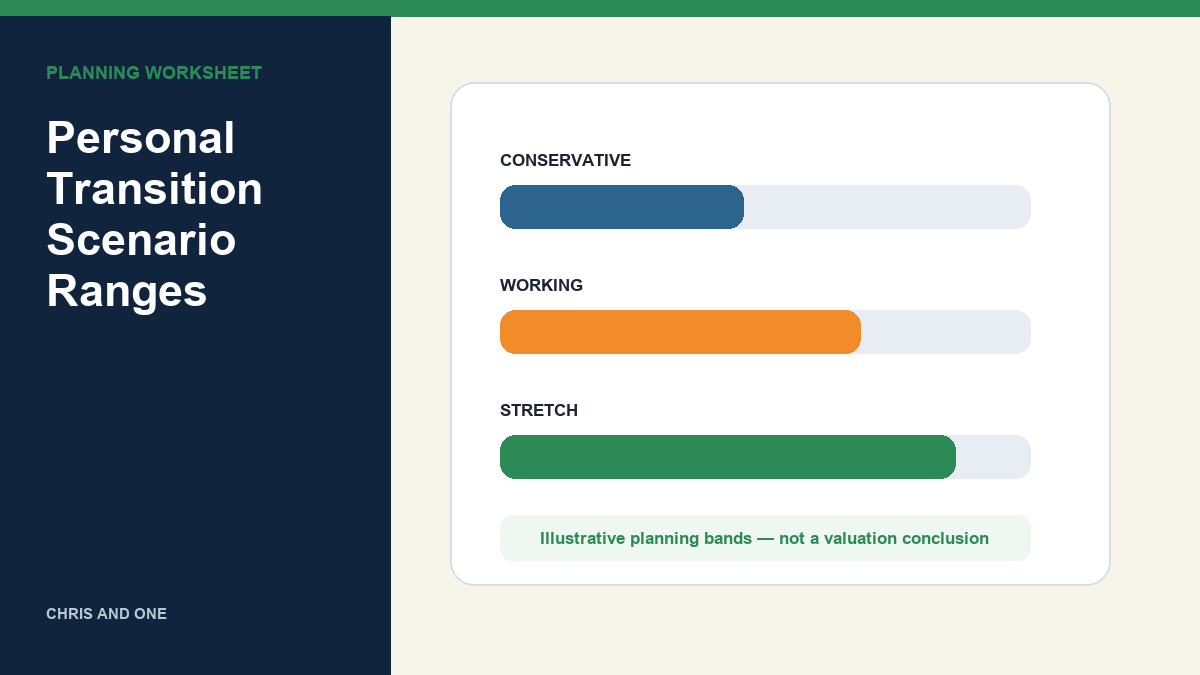
When modeling scenario ranges, individuals can reserve allowances for professional fees, intermediary commissions, administrative costs, and other transaction-specific items instead of treating an early value estimate as spendable proceeds.
The Myth of the Universal Multiple
A pervasive myth in the business community is that enterprise value can be determined by applying a simple, universal multiple to revenue or profit. This misconception leads many individuals to build deeply flawed personal transition budgets based on entirely speculative figures. It is critical to understand that valuations are inherently fact-specific and cannot be reduced to a generalized mathematical formula.
For those exploring how much a business may be worth, the operation’s financial record, systems, client concentration, transferability, and market conditions all affect the analysis. No fixed revenue or profit multiple answers every case.
An Internal Revenue Service legal memorandum discussing Revenue Ruling 59-60 illustrates the fact-specific nature of valuation. It is an IRS legal memorandum, not a universal appraisal standard for every purpose.
A Hypothetical Planning Scenario
To demonstrate the dangers of assuming a fixed multiple, consider this strictly hypothetical scenario. This is an illustrative example only and does not represent a market benchmark or a formal appraisal conclusion.
Imagine a hypothetical owner planning a transition budget around an expected $1 million in net proceeds derived from a generalized industry multiple. The owner commits to new real estate and lifestyle expenses before the figure is verified:
- Scenario A: The transaction closes, but taxes, costs, and liabilities reduce the hypothetical net proceeds to $600,000.
- Scenario B: The process is delayed, conditions change, and the hypothetical net proceeds are $400,000.
Either outcome would leave the original budget overextended. The example is not a forecast; it shows why a personal plan needs room for a different timing or result.
Protecting Identity and Personal Data During Handoffs
During a professional transition, the separation of personal and professional identity often involves the complex untangling of digital accounts, communication channels, and administrative records. Individuals must be vigilant in protecting their personal information throughout this process. The intertwining of personal and business data over years of operation creates a significant risk if not managed with deliberate care.
The Federal Trade Commission, Protecting Personal Information: A Guide for Business advises organizations to know what personal information they hold and dispose of it appropriately. A platform choice does not prove compliance. Personal communications, financial records, and private accounts need deliberate separation from business infrastructure during a handoff.
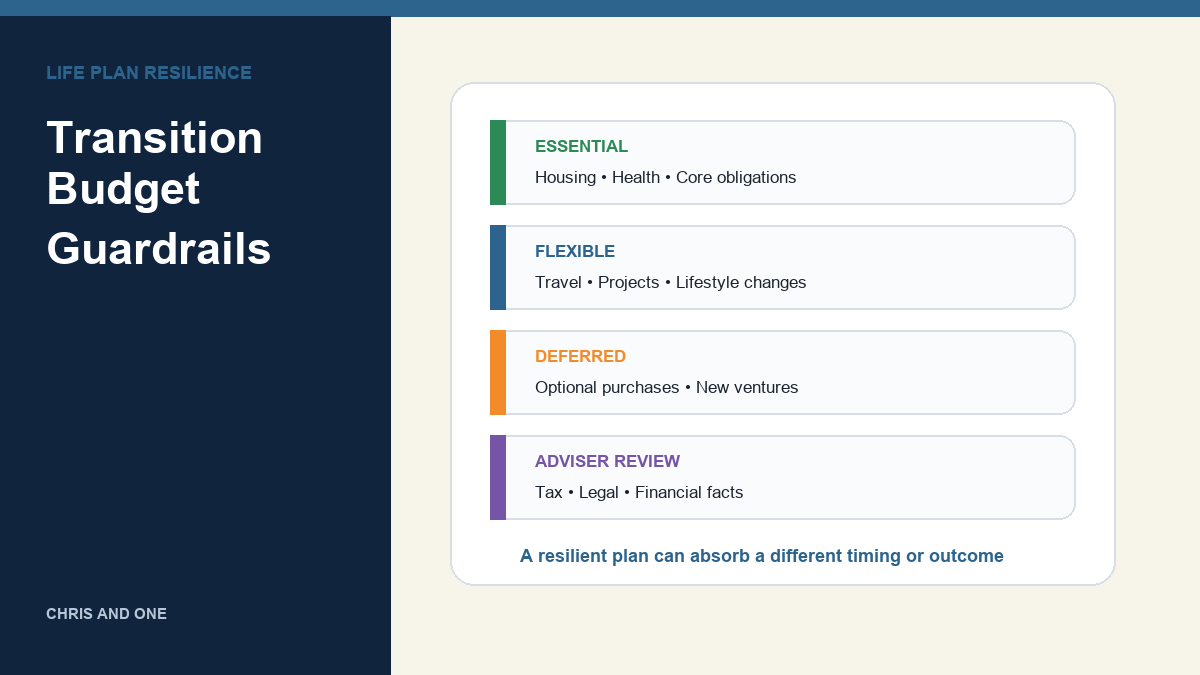
Clear boundaries for post-transition communication also matter. New personal correspondence channels can reduce confusion about which records and accounts belong to the continuing operation.
Checklist for Resilient Transition Planning
Structuring a successful transition requires disciplined adherence to a comprehensive planning methodology. By breaking down the complex process into actionable steps, individuals can maintain control over their personal and financial trajectories. This structured approach minimizes anxiety and ensures that all critical variables are addressed.
Actionable Transition Planning Checklist
- Establish a core personal budget detailing essential living expenses, entirely independent of any anticipated transition proceeds.
- Model three distinct financial scenarios (conservative, moderate, best-case) based on highly varied net proceed assumptions.
- Document and delegate all daily operational responsibilities to achieve structural independence from the enterprise.
- Engage qualified legal and tax advisors to review the transition structure and identify potential liabilities.
- Calculate all anticipated transaction costs, including professional fees and intermediary commissions, and incorporate them into the scenario models.
- Conduct a comprehensive audit of digital accounts to securely isolate and remove all personal data from the operational infrastructure.
- Establish completely independent communication channels and administrative systems for the new personal phase.
After the checklist is drafted, assign a review date to every assumption. Essential expenses may need monthly attention, while an early value estimate may change when financial records are normalized or transaction terms become clearer. Keep the source and date beside each figure so that an adviser can distinguish documented facts from planning placeholders. This simple version-control habit makes the transition budget easier to revise without quietly carrying an outdated estimate into a major personal commitment.
Transition Planning FAQ
Is a business worth three times profit?
No, applying a universal multiplier is fundamentally flawed. Valuations are entirely fact-specific and depend on the unique operational structure, market conditions, and legal foundation of the specific enterprise. Relying on a rigid multiple for transition planning introduces significant personal financial risk.
How much is a business worth with $500,000 in sales?
Sales volume alone cannot determine an operation’s value or the resulting net proceeds. A comprehensive assessment requires evaluating profit margins, operational dependencies, and outstanding liabilities. Transition plans must be built on conservative scenario ranges rather than top-line revenue figures.
How much is a business worth that makes $300,000 a year?
The value relies heavily on the structural independence and systemic stability of the operation. If the income is deeply dependent on the current owner, the value and the feasibility of a clean transition are compromised. Individuals must seek qualified professional advice to understand the specific facts of their situation.
How much is a business worth with $1 million in sales?
Even with high revenue, transaction costs, taxes, and operational adjustments will significantly reduce the final net proceeds available for a personal transition. It is essential to separate the conceptual enterprise valuation from the actual liquid capital that will fund future personal endeavors.
How do I calculate the value of my business?
Determining value requires a rigorous, customized analysis of the operational facts, including intellectual property, audience data, and systemic documentation. Because this process is highly complex and fact-specific, individuals must consult with qualified professional appraisers and advisors rather than relying on generalized formulas to dictate their personal planning.




0 Comments